Overview
As the Financial Times expanded its product range, from core subscriptions to more specialised apps, it became clear that a consistent way of presenting these products was missing. Each one had its own look and feel, which made it harder to maintain a cohesive brand experience across channels.
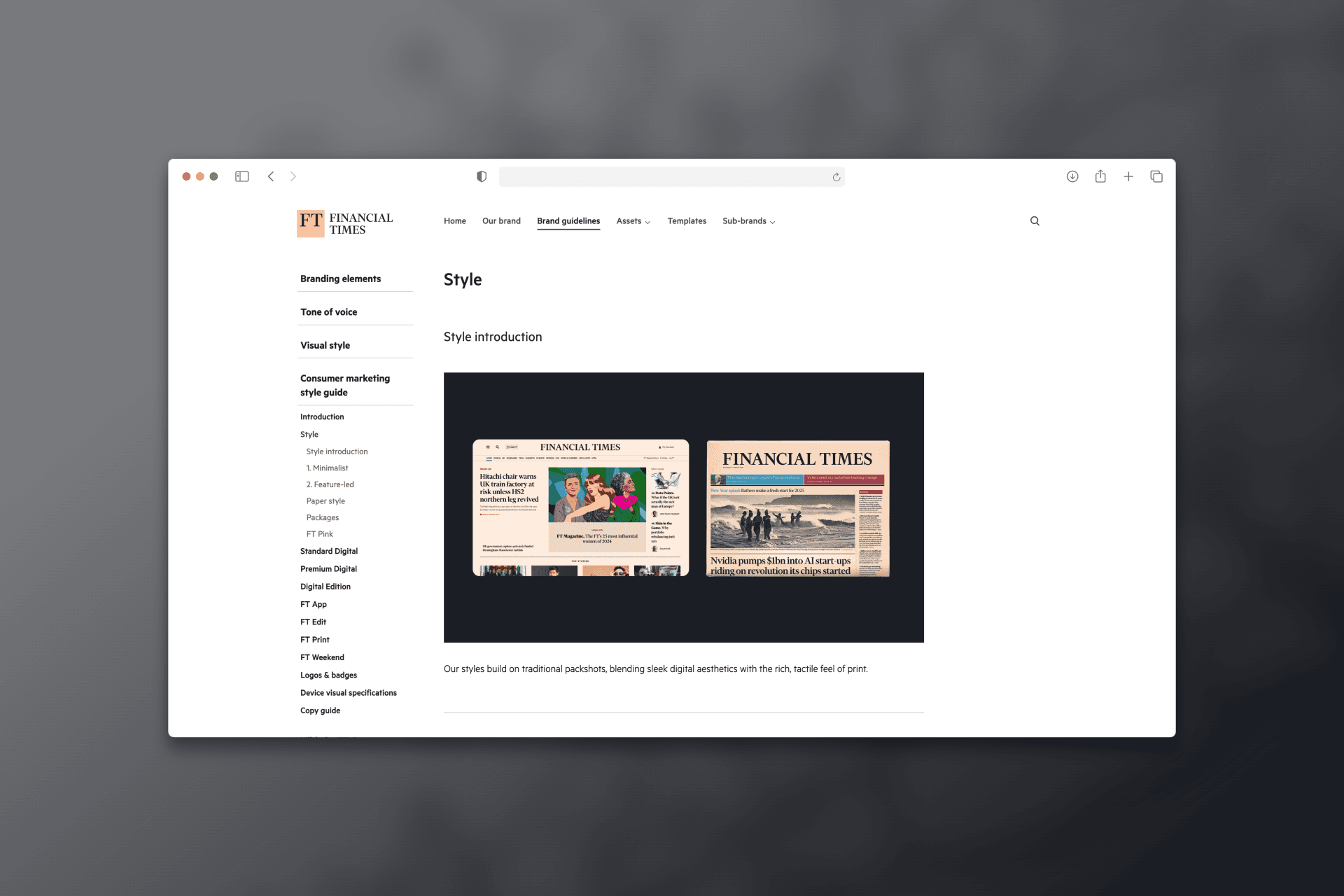
To solve this, we developed the FT Consumer Marketing Style Guide. It brought together the rules for how FT products should appear in marketing, both online and in print. This went beyond logos and colours. It covered how to show devices, how to use gradients and motion, and how to write and design for things like product pages, ads, and promotional imagery.
I led the work on UX messaging, product content structure, and the language used to guide design. My focus was on making sure:
Designers and marketers could clearly represent any FT product, in any context
The visual and UX patterns stayed consistent across platforms
Every layout told a clear story that reflected the product and the wider FT brand
My Role
I was responsible for the full content design of the FT Consumer Marketing Style Guide. That meant shaping the overall structure, writing all the instructional content, and making sure every section was clear, consistent, and usable. As lead UX content strategist, I created a writing system that covered everything from how to show device interfaces and use motion, to how content should be presented and how the brand’s tone should come across.
To keep things accurate and aligned, I worked closely with teams across brand, product, and creative. We reviewed existing assets, identified where things had drifted or become inefficient, and used those insights to define best practices that could scale across channels. The result was a guide grounded in FT’s editorial values and digital standards.
I also played a key role connecting visual design with product strategy. Part of my job was translating big-picture brand principles into clear, actionable UX guidance—guidance that balanced visual consistency with real user needs.
The Challenge
With more than seven products, multiple core platforms, and a mix of internal and agency teams, the FT needed a consistent visual and messaging approach. One that could bring everything together without erasing what made each product distinct.
The main challenges included:
Inconsistent visuals: Packshots differed in layout, cropping, colour treatment, and UI styling from team to team
Brand dilution: FT Pink was often misused or overapplied, weakening its overall impact
No device standards: Elements like shadows, corner radius, and UI placement weren’t defined, creating visual clutter
Too much guesswork: Designers were left to interpret tone, style, and UX conventions on their own
Cross-functional friction: Teams across design, marketing, and development lacked a shared reference point
The solution had to be modular, practical, and scalable—something designers, marketers, developers, and even external agencies could use without needing deep familiarity with the FT brand.
Research & Insights
Before writing the guide, I carried out a detailed audit across teams and channels. This included reviewing how product imagery was being used in emails, social media, app stores, and display ads, as well as digging into internal campaign files, vendor briefs, brand guidelines, and UI documentation. I also looked at platform-specific constraints like Meta’s creative requirements and Google’s device frame policies.
Some of the key insights included:
Standard Digital users mostly accessed the FT on tablets, yet marketing visuals often showed phones
Premium and Standard Digital looked visually identical in most marketing, despite offering different experiences and targeting different audiences
FT Edit needed a bolder, more distinct visual identity to appeal to its younger, mobile-first audience
Visual elements like gradients, shadows, and animation lacked consistency, sometimes creating clutter or weakening the brand
Designers wanted clear, flexible rules rather than overly rigid templates
I also gathered behavioural and audience insights to help shape the tone and messaging:
Different segments responded to different benefits—some valued credibility, others independence or status
Tone needed to shift depending on seniority, sector, and reading preferences
There were signs of product confusion and message fatigue in key channels
Emotional cues like confidence, empowerment, and discovery resonated more than generic selling points
Solution: Messaging Framework Design
To bring consistency across FT’s growing product ecosystem, I designed a modular structure for the style guide. It could flex across all products while staying rooted in a shared design language. Each section followed a repeatable format with clear, practical rules that balanced brand consistency with product-level storytelling.
I wrote tailored content guidance that highlighted which features to prioritise for each product. For example: Lex and premium newsletters for FT Premium, curated daily reads for FT Edit, and print-style layouts for the Digital Edition. This helped teams focus on what mattered most for each audience.
I also created a display strategy for device imagery, based on how different audiences actually engaged with FT products. Desktop for Premium users, tablet for Standard, and mobile for app-based products like Edit. To avoid clutter and maintain visual hierarchy, I introduced layout principles that simplified composition and focused attention where it mattered.
The guide included a full colour system, with HEX, CMYK, and Pantone values, along with clear advice on using gradients with restraint. I defined motion principles using straightforward language, explaining when to use a swipe gesture, when to animate a tile, and when a scroll prompt adds value. Typography and CTA guidance covered headline casing, button tone, and where to place calls to action within a layout. Even details like corner radius and shadow scaling were addressed to maintain visual depth without distraction across devices.
Each product section ended with visual examples of what to do and what to avoid. This helped teams spot common mistakes and apply the standards with confidence. The result was a system that preserved each product’s identity while reinforcing the clarity, authority, and polish that define the FT brand.
Visual Guidelines
To support the visual guidance, I paired each section with clear, purposeful UX writing that explained not just what to do, but why it mattered. Every line was designed to be quick to read, easy to apply, and consistent with the FT’s editorial tone and design values.
For instance, I described FT Pink as “a signal of trust and heritage, never just another colour in the palette” to help teams use it intentionally. In the packshot section, I recommended using a single-device layout to keep the focus sharp and uncluttered. For UI imagery, I suggested removing OS icons like battery indicators and time displays to keep attention on the FT interface. And for Premium assets, I introduced a soft black-to-slate gradient to evoke depth and a sense of luxury, without competing with the content.
These micro-guidelines were built directly into the toolkit and often sat alongside annotated visuals, like the shadow examples shown below. This made the guidance instantly usable and easier to apply across teams.
Impact
This project is already making a measurable and lasting impact across FT’s marketing and product communications.
Product visuals now follow a consistent set of visual and messaging standards across more than seven subscription types
External agencies and new team members can onboard faster, with a clear system to follow
Design and marketing teams work more efficiently thanks to well-defined layout and content guidelines
Branding is stronger and more consistent, with elements like FT Pink and typography used with greater intention
Collaboration between product, design, and marketing has improved, as teams now share a common visual and verbal foundation
The style guide has become the go-to reference for product marketing at the FT, helping ensure consistency across global campaigns, whether paid, owned, or earned.
Learnings & Reflections
This project was a clear reminder of how closely content, UX, and design systems are connected. A brand’s identity isn’t just about colours or logos. It’s about how those elements are explained, applied, and repeated across every touchpoint. Small visual choices can have a big impact on trust, recognition, and conversion.
A few key lessons stood out:
Systems only work if they scale. If a rule doesn’t hold up across devices, it won’t hold up at all
UX writing needs to communicate the reasoning behind choices, not just the rules themselves
A good style guide gives teams clarity and confidence. It doesn’t box them in
Voice and visuals work together. If one feels off, the whole experience suffers
By translating abstract brand principles into clear, actionable UX guidance, we built a system that helps teams move faster, stay aligned, and uphold the quality users expect from the FT across any platform or campaign.
(Some) Designs
Product Style Guide
Financial Times
2025
The FT Consumer Marketing Style Guide is a cross-channel brand framework created to bring consistency to how Financial Times products are presented across digital and print marketing touchpoints, enabling a cohesive visual and messaging system across subscriptions, apps, ads, and promotional experiences.
... Seb brought a much needed pair of fresh eyes and delivered beyond our expections.

Bill M.
CEO of ACrew4U

App Onboarding
Financial Times
2025
Overview
Overview
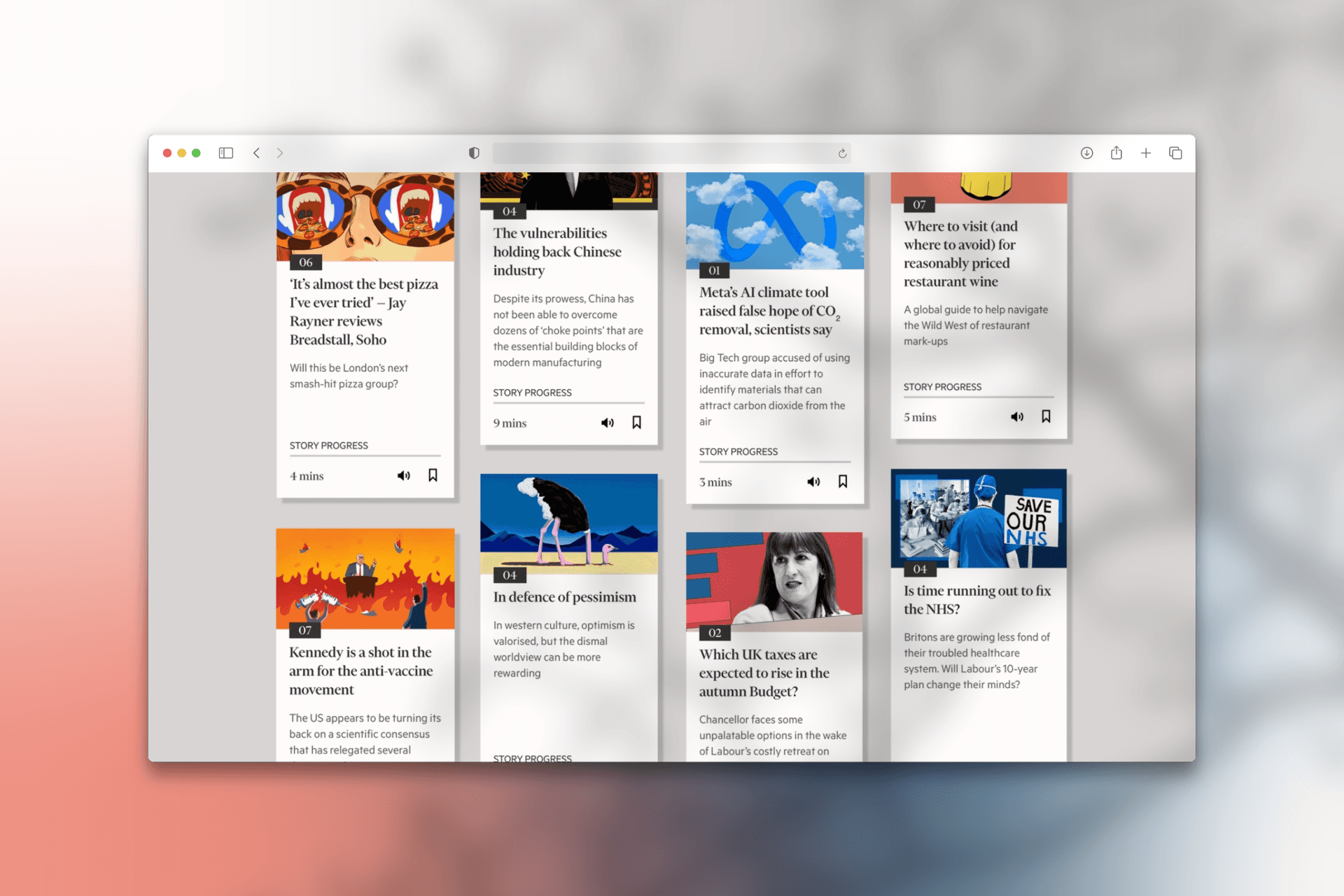
FT Edit is a curated, mobile-first editorial product from the Financial Times, designed to offer a slower, more intentional news experience through a daily selection of eight handpicked articles. In Q2 2025, we began migrating FT Edit into the main FT iOS app, replacing the standalone version as the primary way to access the product.
The goal was to reduce fragmentation, make app discovery easier, and allow users to subscribe directly within the main app. The challenge was to retain FT Edit’s calm, focused feel while integrating it into a much busier and more complex environment. My role was to shape a smooth and thoughtful user journey that worked across different areas of the app and different subscription states, so that no matter how someone entered the FT ecosystem, they could easily find and use FT Edit.
Impact and key results
28% of existing FT Edit standalone app users migrated to the integrated FT app experience within the first four weeks after launch, surpassing the initial expectation of 20%.
Trial activations increased by approximately 15% due to the introduction of preview content and a soft registration flow that lowered entry barriers for new users.
Qualitative feedback gathered from user surveys and support channels indicated strong satisfaction, with many users commenting that the transition felt “seamless” and “unobtrusive,” preserving the editorial tone and reading experience they valued.
My Role
I led the UX strategy for the migration, working closely with product and design teams to map out entry points, streamline transitions between apps, and ensure user flows aligned with subscription logic. This included defining user states, access levels, and content journeys based on whether someone was anonymous, registered, subscribed, or on a trial.I also helped design the migration experience for existing FT Edit users and also helped to support discoverability, purchase flows, and post-migration retention within the main app.
The Challenge
The primary challenge was balancing preservation of FT Edit’s editorial calmness and simplicity with the realities of integration into a more feature-rich app. FT Edit users were highly sensitive to changes in tone, layout, or flow, any disruption risked alienating loyal readers.
Other challenges included:
Supporting multiple user states: Existing subscribers needed seamless migration, new users required gentle onboarding, and FT app subscribers unfamiliar with FT Edit deserved clear, non-intrusive promotion.
Subscription complexity: The migration coincided with launching Apple in-app purchase flows, adding monthly and annual plans that had to align with Apple’s strict policies and billing mechanisms.
Discoverability without confusion: FT Edit had to be prominent enough to attract new users but not so loud as to cannibalise other FT content or overwhelm users.
Continuity: It was vital that the transition felt like a natural evolution rather than a disruptive change.
Research and Discovery
To understand the nuances of FT Edit users and prepare for migration, I undertook a discovery phase:
Behavioural data analysis: Using Amplitude, I analysed in-app behaviour to uncover patterns in engagement and friction points:
Average session length: 4.6 minutes (vs. 3.8 minutes on FT app)
Article completion rate: 61% (vs. 47% benchmark on FT app) These insights highlighted opportunities to reduce friction in trial flows and improve onboarding clarity.
User interviews and surveys: We gathered qualitative feedback from existing FT Edit subscribers through customer care to learn what they valued most about the product, what caused frustration, and their expectations for the migration. Many emphasised the value of simplicity and the uncluttered approach.
Support and feedback logs: I analysed tickets and comments to identify recurring pain points for both apps, seeing where improvements could be made with a new version of the Edit.
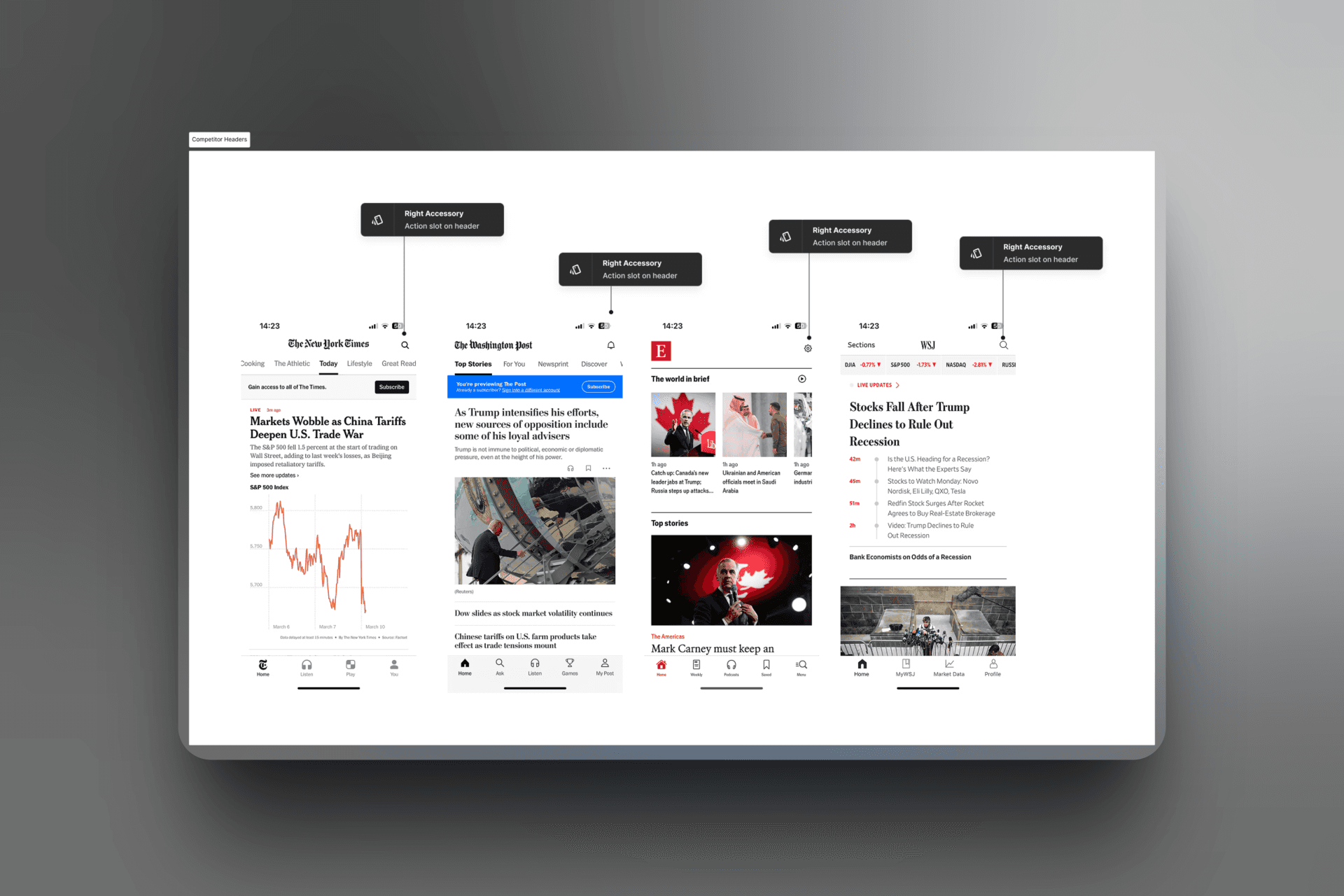
Competitive benchmarking: I studied how similar publishers (The New York Times) had successfully integrated niche products (like NYT Cooking) into their main apps, extracting lessons about navigation, subscription management, and user onboarding. (This gave us lots of ideas to start tesing in the design phase)
Stakeholder workshops: Sessions with product owners, engineers, editorial, and legal teams helped to clarify business goals, technical limitations, and compliance requirements.
The 3.8-minute average session length and 61% article completion rate (both outperforming FT app benchmarks) validated that FT Edit’s compact, curated format was resonating. This reinforced the need to preserve editorial simplicity in the integrated experience, guiding our early navigation designs toward a dedicated, distraction-free content surface within the main FT app.
User Journey Mapping
With research insights in hand, I mapped four primary user journeys.
Existing FT Edit subscribers
Needed an effortless, one-tap migration from the standalone app to the integrated FT app experience.
Expected to find the familiar editorial structure, interaction patterns swipe navigation), and visual tone intact.
Required clear reassurance that no content or features were lost.
Anonymous or registered non-subscribers
Needed a low-friction introduction with preview content access before committing to registration or payment.
The flow needed to encourage trial activation through soft gating like banners, modals, or inline messages rather than aggressive paywalls.
FT app subscribers unfamiliar with FT Edit
Required gentle promotion via homepage modules and subtle in-app messaging that framed FT Edit as an editorial bonus rather than a sales pitch.
Needed clear but unobtrusive pathways to explore the curated content.
New users via the App Store
Needed an upfront subscription selector with clear monthly and annual plans that aligned with web and Apple store pricing and options.
The onboarding journey had to be straightforward and aligned with FT Edit’s editorial values.
Concepts & Wireframing
Early-stage wireframes explored several hypotheses and navigational options:
The redirect from the standalone FT Edit app to the integrated FT app, including messaging and button placement on the transition screen.
Entry points from the FT app homepage, subscription screens, and push notifications leading to FT Edit content.
Preview article layouts for non-subscribed users, balancing enough content to engage while preserving subscription value.
Subscription plan selector UI incorporating monthly and annual billing with Apple in-app purchase compliance.
I developed multiple layout concepts to preserve FT Edit’s minimalist, editorial aesthetic while fitting within the FT app’s design system. This included:
Card-based content feeds with consistent headline hierarchies and narrow typography palettes (similar to what was implemented in the standalone app)
Strategic placement of the FT Edit tile on the homepage and subscription screens.
Flow variants to handle returning users with incomplete registrations or trials.
Stakeholder walkthroughs provided valuable feedback, especially on error handling, gating clarity, and visual hierarchy. These sessions informed iterations and helped define a robust foundation for UI design.
Creating Final Designs
I focused on ensuring:
Retention of FT Edit’s signature minimalist design, characterised by a soft, neutral colour palette and clean, readable typography.
Consistency in user interaction patterns, such as swipe gestures and scroll behaviour, matching the standalone app to maintain familiarity.
Clear and calm microcopy that reinforced editorial tone and reduced cognitive load, avoiding overly promotional language.
Compliance with accessibility standards, including high contrast ratios.
Final User flows
The final user journeys included:
Standalone FT Edit users: Upon opening the original app, they encountered a migration screen with a clear message and a single button that launched the FT app’s FT Edit section. They landed directly in the curated feed, which retained the same editorial hierarchy, layout, and swipe interactions as before.
Returning subscribers: Experienced uninterrupted access to their familiar content with no modal interruptions or confusing changes.
New or anonymous users: Entered a preview mode allowing access to article headlines and intros before a soft prompt for registration and trial activation.
Subscription page visitors: Found FT Edit monthly and annual plans integrated into the app’s main product selection screen, with clear explanations of benefits and billing terms.
FT app subscribers unfamiliar with FT Edit: Saw FT Edit positioned as a valuable editorial feature, accessible via homepage tiles and unobtrusive banners.
Push notifications and in-app messages: Reinforced awareness and re-engagement with FT Edit content without overwhelming users.
Collaboration
The success of this complex migration was rooted in strong cross-functional collaboration:
Product management ensured the project stayed aligned with strategic business objectives and timelines.
Design team refined UI elements and interaction details to maintain editorial consistency and accessibility.
Engineering implemented robust routing, gating, and billing validation systems to handle multiple user states reliably.
Marketing and editorial teams developed consistent messaging across onboarding, push notifications, and in-app banners.
Legal and compliance reviewed subscription plans and messaging to ensure adherence to Apple’s policies and regulatory requirements.
The team adopted two-week sprint cycles with daily stand-ups and demos.
Results & Adoption
The integration launched to existing subscribers in April 2025, with the public rollout following soon after. By the end of May, around 28% of FT Edit app subscribers had started using the product within the main FT app. In-app purchases, including the new annual plan, are now live and showing stable performance.
Engagement from registered users and anonymous visitors is growing steadily as FT Edit becomes more visible within the app. We’re actively monitoring the conversion funnel to fine-tune registration prompts and subscription calls to action.

Seb Sadler
Open to work
Seb Sadler
Open to work